Who is credited with the invention of the typewriter?
Christopher Sholes.
What is a "stenographer"?
someone skilled in the transcription of speech
Post an example of Shole's typewriter.
Why did Sholes send a prototype of his typewriter to Clephane?
when beginning to pursue commercial development, he realized stenographers would be among the first and most important users.
After the typewriter began production, why did Clephane pursue another machine?
it solved only part of his problem, it still took long to typeset and
copy the words. bridge the gap between the typewriter and the printed
page.
Who spent a year redesigning Clephane's typesetting machine?
Mergenthaler
What is meant by "typesetting"?
commercially successful
Post an example of Linotype Machine.
How does the Linotype Machine differ from the typewriter?
allowed type to be set mechanically rather than by hand
How did this machine change the newspaper industry?
making it possible for a small number of operators to set type for more pages on a daily basis
Post an example of a Linotype keyboard.
How did the keyboard of the Linotype Machine differ from keyboards that we use today?
90 charcter keyboard
there was no shift key
therefore, uppercase letters has separate keys from lowercase letters.
the arrangement of keys was based on letter frequency.
Post an example of a Linotype slug.
What is a slug?
the assembled line of type is then cast as a single piece
Post an example of a person operating a Linotype Machine.
N/A
Why is the Linotype Machine the greatest advanced in printing since movable type?
allowed for faster typesetting than by hand
Friday, May 4, 2012
Logotypes
logotypes are emblems commonly used by commercial enterprises, organizations, and even individuals to promote public recognition.
numerous inventions and techniques have contributed to the contemporary logo....including logo graphics languages,such as Egyptian hieroglyphics
cats of arms,watermarks and the development of the printing technology
as the industrial revolution developed in the 18th and 19th centuries,photography and lithography contributed to the boom of an advertising industry that integrated typography and imagery together on the page
as the time topography itself was undergoing a revolution of form and expression that expanded beyond the modest serif typefaces used in books
the art were expanding in purpose from expression and decoration of an artistic story telling nature to a different of brands and products that the growing middle classes were consuming
consultancies and trades groups in the commercial arts were growing and organizing by 1890 the US had 700 lithographic printing firms employing more than 8000 people
playful children books authoritative newspapers and conversational periodicals developed their ow visual and editorial styles for unique expanding audiences
as printing cost decreased literacy rates increased and visual styles changed the victorian decorative arts lead to an expansion of typographic styles and methods of representing businesses
by 1950 modernism has shed its roots as an avant grade artistic movement
the visual simplicity and conceptual clarity that were hallmarks of modernism as an artistic movement
less is more proved successful in the era of mass visual communications
important area of graphic design
logo are meant to represent companies brands or corporate identities and foster their immediate customer
real life situations do not stare at and analyze logo
see quick and glance
5 principles of logo design:
numerous inventions and techniques have contributed to the contemporary logo....including logo graphics languages,such as Egyptian hieroglyphics
cats of arms,watermarks and the development of the printing technology
as the industrial revolution developed in the 18th and 19th centuries,photography and lithography contributed to the boom of an advertising industry that integrated typography and imagery together on the page
as the time topography itself was undergoing a revolution of form and expression that expanded beyond the modest serif typefaces used in books
the art were expanding in purpose from expression and decoration of an artistic story telling nature to a different of brands and products that the growing middle classes were consuming
consultancies and trades groups in the commercial arts were growing and organizing by 1890 the US had 700 lithographic printing firms employing more than 8000 people
playful children books authoritative newspapers and conversational periodicals developed their ow visual and editorial styles for unique expanding audiences
as printing cost decreased literacy rates increased and visual styles changed the victorian decorative arts lead to an expansion of typographic styles and methods of representing businesses
by 1950 modernism has shed its roots as an avant grade artistic movement
the visual simplicity and conceptual clarity that were hallmarks of modernism as an artistic movement
less is more proved successful in the era of mass visual communications
important area of graphic design
logo are meant to represent companies brands or corporate identities and foster their immediate customer
real life situations do not stare at and analyze logo
see quick and glance
5 principles of logo design:
- simple:
- memorable
- timeless
- versatile
- appropriate
makes
a logo design easily recognizable, versatile, and memorable good logo
featured something unexpected or unique without being over drawn.
works across a variety of media and applications.
how you position the logo should be appropriate for its intended audience.
Four color process: technique for printing with full color. (cmyk)
spot
color: method of specifying and printing colors in which each color is
printed with its own ink. spot color printing is effective when the
printing matter contains only one to three different colors, but becomes
more expensive for more color.
Pantone Matching System.
Combination
mark: are graphics with both text and a symbolized/icon that signifies
the brand image that you wish to project for your company or
organization.
iconic
/ symbolic: icon and symbols are compelling yet uncomplicated images
that are emblematic of a particular company or product.
wordmark/ lettermark: use a company name as a whole. lettermark is the initials
Stationary Package
stationary package: the printed pieced that company utilizes for communication purpose.
when establishing a business, it is important that all communications are well coordinated and that the message of the organization is presented consistently.
includes: business cards, letterhead, and envelope
business card: an essential part of a stationary design, when you hand someone your business card, they will form an immediate opinion about your company. your business card does more than tell people hot to find you: it says something about your company- its culture, and its goal. everything from the color, fonts, the texture, shade, and gloss
typically includes:
design tips:
when establishing a business, it is important that all communications are well coordinated and that the message of the organization is presented consistently.
includes: business cards, letterhead, and envelope
business card: an essential part of a stationary design, when you hand someone your business card, they will form an immediate opinion about your company. your business card does more than tell people hot to find you: it says something about your company- its culture, and its goal. everything from the color, fonts, the texture, shade, and gloss
typically includes:
- logo
- company name
- employee name
- title
- phone number
- fax number
- email address
- company address
- web address
design tips:
- must be 2"x 3.5"
- horizontal OR vertical orientation
- check for accuracy
- check for unity... continuity among other pieces
letterhead: a printed piece of paper used to send letters, memos, etc.
includes:
- logo
- company name
- company address
- phone number
- fax number
- web address
- must be 8.5"X11" (standard)
- must be vertical orientation
- must leave room to write the letter, memo, etc-big empty space in middle
- check for accuracy
- check for unity
Envelopes: the packaging the contains the letter/form when being mailed, standard 10
includes:
- logo
- company name
- company address
design tips:
- must be 9.9'x4.125'
- horizontal OR vertical orientation
- must leave room for recipient's address and stamp
- check for accuracy
- check for unity...continuity among other pieces
Wednesday, April 18, 2012
#17 research and inspiration
when making a logo it has to be simple and memorable. So as inspiration I thought of some really obvious logos. They gave me ideas for my logo.
| Who doesn't know batman? And everyone loves a superhero. |
| McDonalds is all over the world it's practically the symbol of America, one that we shouldn't be proud of...but hey we're Americans so it's alright. Haha! |
Thursday, March 15, 2012
Assignment #16 inspiration
![]() |
I think this is adorable. I love how it spirals down and into other time periods. It really leads you through the history of dinosaurs. That's also a plus, dinosaurs rock. |
Monday, March 12, 2012
History #6 The Gutenburg Press
What is Johannes Gutenberg credited with?
invention of the gutenberg printing press
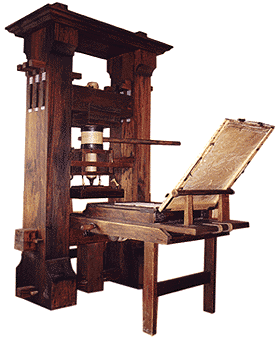
Post a photo of the Gutenberg Press.
How did the printing press work?
What motivated Gutenberg to find a better way of creating books?
Why did Gutenberg experiment with metal type versus wood type?
Post an example of movable type in a type case.
What is moveable type?
Movable type is the system of printing that uses movable components to reproduce the elements of a document
Post an example of a 1930s printing press.
By the late 1930s, presses had increased in efficiency and were capable of 2,500 to 3,500 impressions per hour. What is meant by "impression"? paper pressed through it leaving text and images on the paper
Which printing process is the Gutenberg press an example of? Briefly describe the process?
In the Gutenberg Press, ink was rolled over the raised surface of movable hand-set bloc letters held within a wooden form. The Gutenberg Press is an example of relief printing
Post an example of an intaglio press.
What is intaglio printing and how is ink transferred?
The image area is etched into the plate surface to hold ink, then damp paper is placed on top, add pressure, and then the ink is transferred to the paper.
Post an example of a screen (porous) printing press.
What is porous printing and how is ink transferred?
The image carrier is attached to a screen and then the ink is forced through open mesh areas
Post an example of a lithography printing press.
What is lithography and how is ink transferred?
Drawings or artwork is made on a plate with greasy ink or crayon; then the ink is spread on top, the greasy parts accept the ink
What variation of lithography is used by the commercial printing industry today?
The presses used today are faster, cheaper and can do more than just letters on paper
How do printing presses used today compare to the Gutenberg Press?Describe four-color process printing using CMYK?
Different color ink (cyan, magenta, yellow, and black) can make many colors, when mixed correctly. This color process is best for printing because it uses ink, not light like the Internet.
invention of the gutenberg printing press
Post a photo of the Gutenberg Press.
How did the printing press work?
What motivated Gutenberg to find a better way of creating books?
Why did Gutenberg experiment with metal type versus wood type?
Post an example of movable type in a type case.
What is moveable type?
Movable type is the system of printing that uses movable components to reproduce the elements of a document
Post an example of a 1930s printing press.
By the late 1930s, presses had increased in efficiency and were capable of 2,500 to 3,500 impressions per hour. What is meant by "impression"? paper pressed through it leaving text and images on the paper
Which printing process is the Gutenberg press an example of? Briefly describe the process?
In the Gutenberg Press, ink was rolled over the raised surface of movable hand-set bloc letters held within a wooden form. The Gutenberg Press is an example of relief printing
Post an example of an intaglio press.
What is intaglio printing and how is ink transferred?
The image area is etched into the plate surface to hold ink, then damp paper is placed on top, add pressure, and then the ink is transferred to the paper.
Post an example of a screen (porous) printing press.
What is porous printing and how is ink transferred?
The image carrier is attached to a screen and then the ink is forced through open mesh areas
Post an example of a lithography printing press.
What is lithography and how is ink transferred?
Drawings or artwork is made on a plate with greasy ink or crayon; then the ink is spread on top, the greasy parts accept the ink
What variation of lithography is used by the commercial printing industry today?
The presses used today are faster, cheaper and can do more than just letters on paper
How do printing presses used today compare to the Gutenberg Press?Describe four-color process printing using CMYK?
Different color ink (cyan, magenta, yellow, and black) can make many colors, when mixed correctly. This color process is best for printing because it uses ink, not light like the Internet.
History #5. The Book
Post an example of a scroll.
What were the drawbacks of the scroll?
Readers had to read the text in the order it was written and they were only allowed for sequential usage.
Post an example of a codex.
What is a codex?
A book bound with wood and string
"Codex" is derived from the Latin meaning "block of wood". Why?
it was made with wood and wasn't supposed to be folded or rolled up
What is the difference between "sequential access" and "random access"?
With random access, a reader can read a certain page or part of the page; sequential access required the reader to read the entire thing.
What were the advantages of using the codex?
It was compacted, sturdy and easy reference because it was random access. It was also good for libraries because the title could be written on the spine.
What helped spread the use of the codex?
Creation of the Bible
What replaced papyrus? Describe the process used to create it?
Parchment was made from animal skin, smoothed out, soak the hide in water, add calcium, flour and salt, and then they dried it.
What is Vellum?
Finer quality of parchment, made from the skins of young calves.
What led to a period of cultural and economical deterioration?
Decline of the Roman empire
Name several examples of current technology that utilizes the format of the codex?
book binding, and the format in general became slightly more sophisticated but the overall format has barely changed.
Post an example of an illuminated manuscript.
Who began creating books by hand, taking the creation to an art form?
Monastic monks in the Dark Ages.
What does "illumination" refer to? What was included in this ornamentation?
The borders, with the initials of the chapters or paragraphs with painting in the margins, borders and around the text
What tool was used for creating the illuminated manuscripts?
Quill pens
Why were these manuscripts reserved for religious purposes?
It was decided that the beautiful books should be used for church use, especially because most of the population was illiterate.
What is craftsmanship? Why is it important?
art or a craft. It is important for historians to see what the culture was like.
What were the drawbacks of the scroll?
Readers had to read the text in the order it was written and they were only allowed for sequential usage.
Post an example of a codex.
What is a codex?
A book bound with wood and string
"Codex" is derived from the Latin meaning "block of wood". Why?
it was made with wood and wasn't supposed to be folded or rolled up
What is the difference between "sequential access" and "random access"?
With random access, a reader can read a certain page or part of the page; sequential access required the reader to read the entire thing.
What were the advantages of using the codex?
It was compacted, sturdy and easy reference because it was random access. It was also good for libraries because the title could be written on the spine.
What helped spread the use of the codex?
Creation of the Bible
What replaced papyrus? Describe the process used to create it?
Parchment was made from animal skin, smoothed out, soak the hide in water, add calcium, flour and salt, and then they dried it.
What is Vellum?
Finer quality of parchment, made from the skins of young calves.
What led to a period of cultural and economical deterioration?
Decline of the Roman empire
Name several examples of current technology that utilizes the format of the codex?
book binding, and the format in general became slightly more sophisticated but the overall format has barely changed.
Post an example of an illuminated manuscript.
Who began creating books by hand, taking the creation to an art form?
Monastic monks in the Dark Ages.
What does "illumination" refer to? What was included in this ornamentation?
The borders, with the initials of the chapters or paragraphs with painting in the margins, borders and around the text
What tool was used for creating the illuminated manuscripts?
Quill pens
Why were these manuscripts reserved for religious purposes?
It was decided that the beautiful books should be used for church use, especially because most of the population was illiterate.
What is craftsmanship? Why is it important?
art or a craft. It is important for historians to see what the culture was like.
Subscribe to:
Posts (Atom)